
Perk obligations sorter
Tick the perks you plan to use. Read what each one asks of you, what it takes away, and where two of them bite on each other.
Sort your perks
Tick at least one perk to see what it asks of you.
How to use the tool
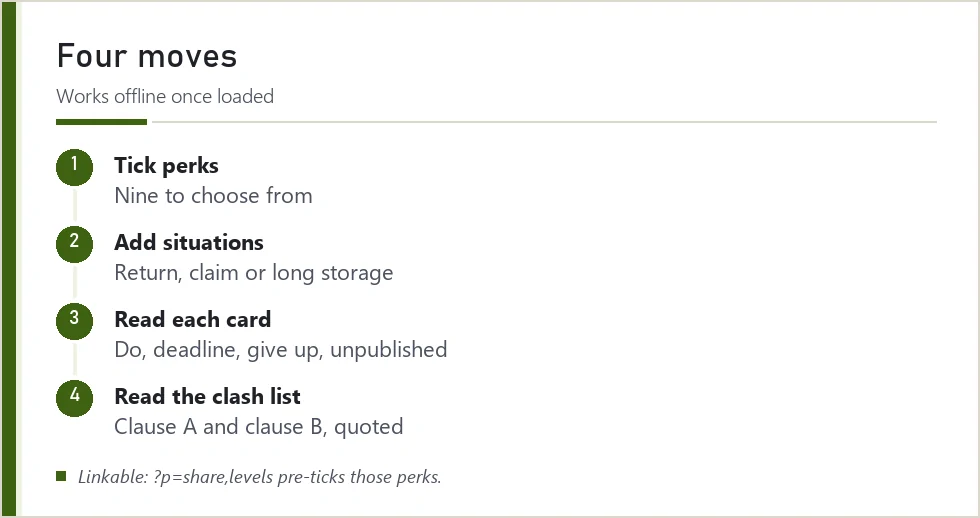
Tick every perk you expect to touch on your next order, including the ones you are only considering. Then add a situation if it might apply: a return, a damage claim, or items waiting longer than 90 days. The tool redraws as you tick. Each perk gets a card with four columns, and below the cards a numbered list shows each pair of picks that touches the same rule.
You can link straight to a set of picks. Adding ?p=share,levels to the page address ticks those two on arrival; the perk pages on this site use that to open the sorter with their own perk selected. Nothing is stored or sent anywhere. The rule set lives in one small script on this site.
The four columns explained
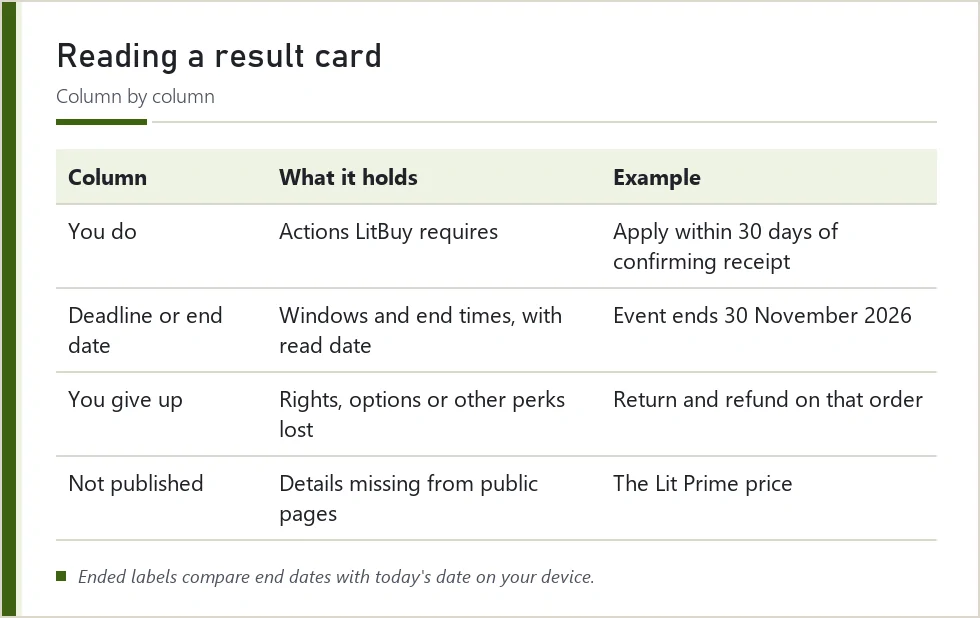
You do lists the actions LitBuy's text requires: collecting, applying, posting, checking in, renewing. Deadline or end date quotes the window or the end time, with the date we read it, and the card shows a red Ended label once the saved event end date has passed in Beijing time; the pool is flagged separately because its entries have different end dates. You give up lists what the perk costs in rights, options or other perks. Not published by LitBuy lists the details a careful reader would want and cannot find on a public page.
Where LitBuy pages disagree with each other, the card carries a note in a yellow-edged box. Two perks have one today: the Discord coupon (a dead footer invite) and the spin wheel (a badge that shows dollar figures while the event feed lists percentage coupons).
The four kinds of collision
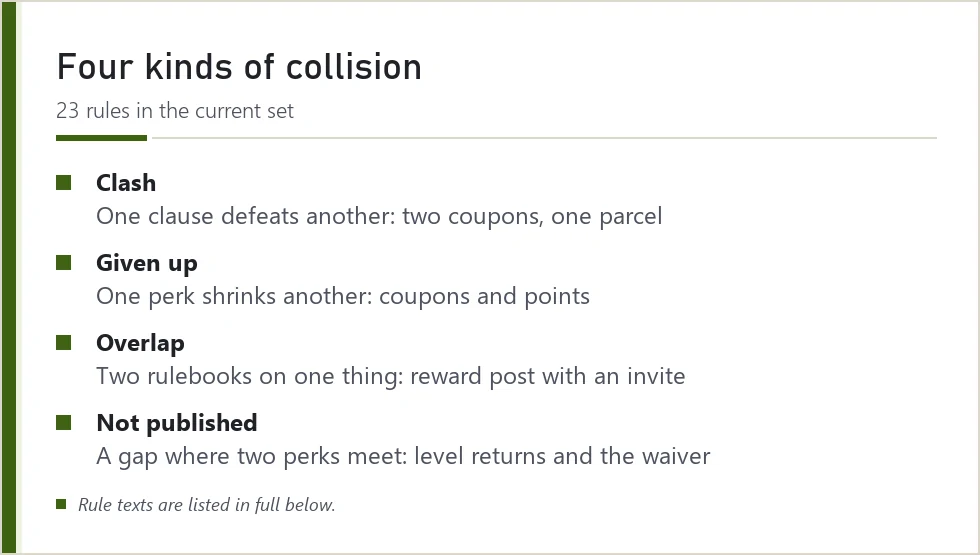
Clash: one clause defeats or limits another. Two shipping coupons on one parcel is the commonest; the share reward against a planned return is the costliest. Given up: using one perk reduces another, as when the coupon-covered part of shipping earns no points. Overlap: two rulebooks bind the same thing, such as a reward post that also carries your invite link. Not published: two perks meet in a place LitBuy has not described, such as level return benefits against the share waiver.
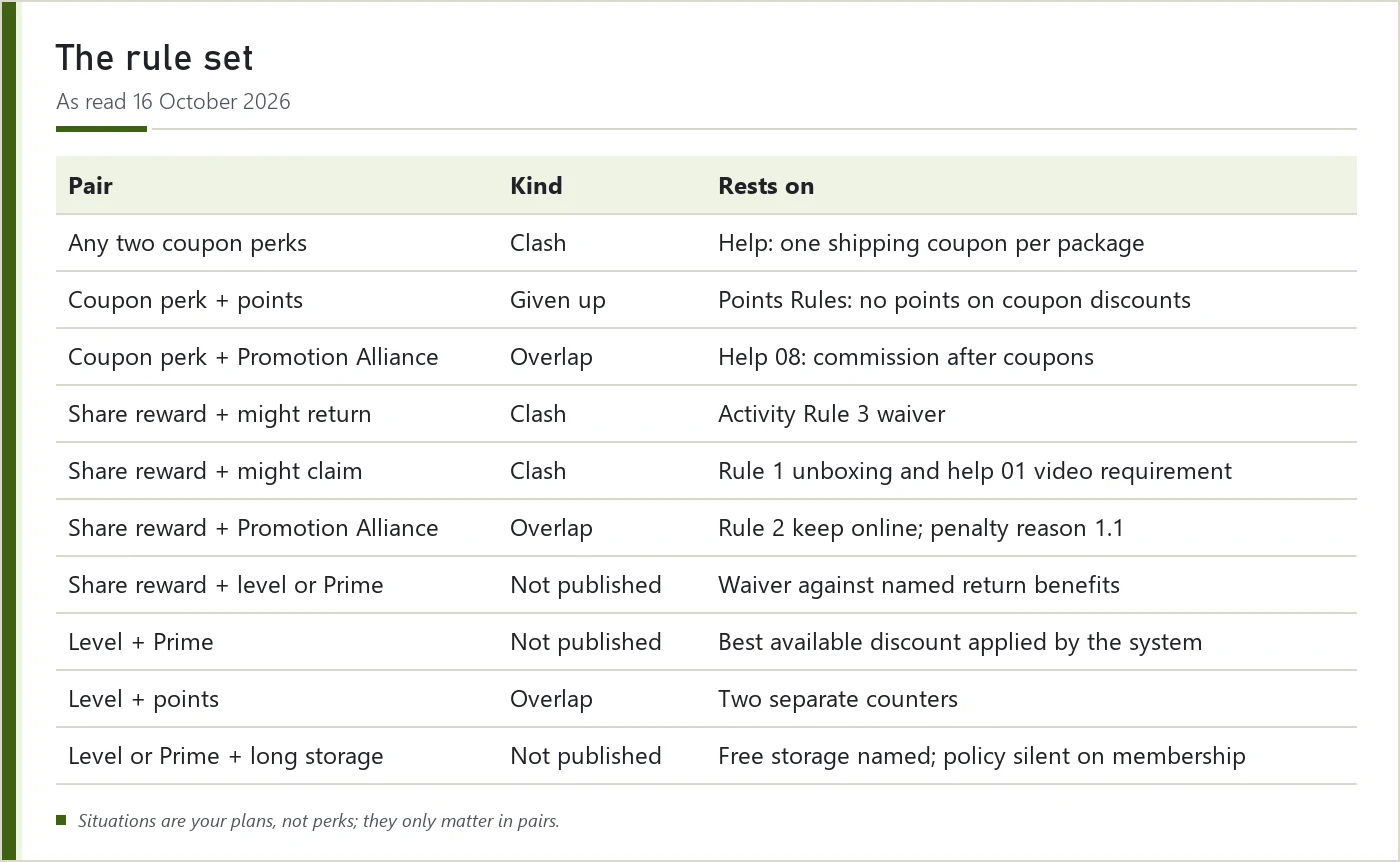
With every perk and every situation ticked, the tool fires 23 rules. Each one quotes LitBuy's wording or a close paraphrase labelled as such, and none of them ends with advice from us beyond what follows from the text.
Every rule the sorter checks
The table lists the rule families. Coupon rules fire for every pair among the four coupon perks, so six slot clashes are possible, plus one points rule and one commission rule per coupon perk.
What the sorter will not do
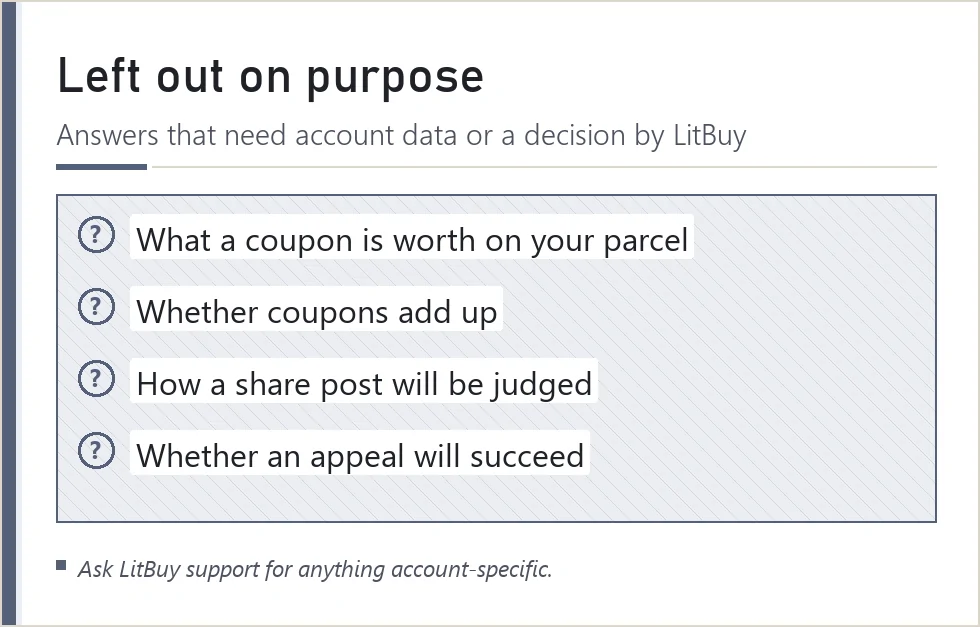
It will not tell you what a coupon is worth, add coupons together, or rank perks. Those answers depend on figures LitBuy shows only inside an account, and on the route and weight of a parcel that does not exist yet. It also lists no codes; LitBuy's coupons are collected into accounts, and a code copied from elsewhere is a different thing with its own rules.
It will not predict how a person at LitBuy reviews a share post, or whether an appeal in the Promotion Alliance succeeds. Those are decisions, not rules.
And it will not keep itself current. When LitBuy changes a rule, the script changes only after we read the new text; the read date at the top of the page tells you how fresh the rule set is.
Next set of terms: Share reward terms